Saudade and homecoming: organizing eight months of transition for two in a single shared notebook
Five years in Lyon. The children speak French at school and Portuguese at home. The grandmother in Coimbra is getting older, and no one in the family can bear to see time pass from afar anymore. In January, the decision is made. Return to Portugal in September. Eight months to prepare for a return that no one in the family had really planned, because it was a diffuse dream, and which suddenly becomes a hundred very concrete decisions.
Returning home after several years abroad doesn't get complicated on the day of arrival. The plane lands, the suitcases arrive, the cousins wait at Sá Carneiro airport. What gets complicated are the eight months before and the three months after. Enrollment in the Portuguese school that requires translated foreign certificates. The international move with everything that needs to be declared at customs. The house to rent remotely with a Portuguese guarantor that most agencies require. The family doctor to choose in a municipality where you no longer know anyone. The NIF to reactivate, social security to transfer, the bank to open, the driving license to convert. And the grandmother who asks every week on WhatsApp if everything is going well.
Key points
- Returning home after five years abroad involves about a hundred administrative, family, and logistical decisions spread over eight to twelve months, with at least seven interlocutors (spouse, children, parents who stayed in the country, Portuguese school, real estate agency, mover, French and Portuguese administration in parallel).
- A single shared binder with seven sub-folders (Documents, Housing, Family, Moving, Budget, Schools, Support) covers the seven mental piles that a return generates, without leaving anything dormant in a forgotten email inbox.
- The three access levels allow you to include parents who stayed in Portugal, the international mover, and the new school without exposing everything. Everyone sees what concerns them, nothing more.
- Voice dictation captures ideas as they arrive (on the subway on the way to work, after a conversation with an aunt, at the end of the day after calling the school), instead of losing them in the daily chaos of the eight months of waiting.
- The assistant's memory retains once and for all the language spoken at home, the destination municipality, the name of the new school, and stops re-asking for this context in every voice conversation.
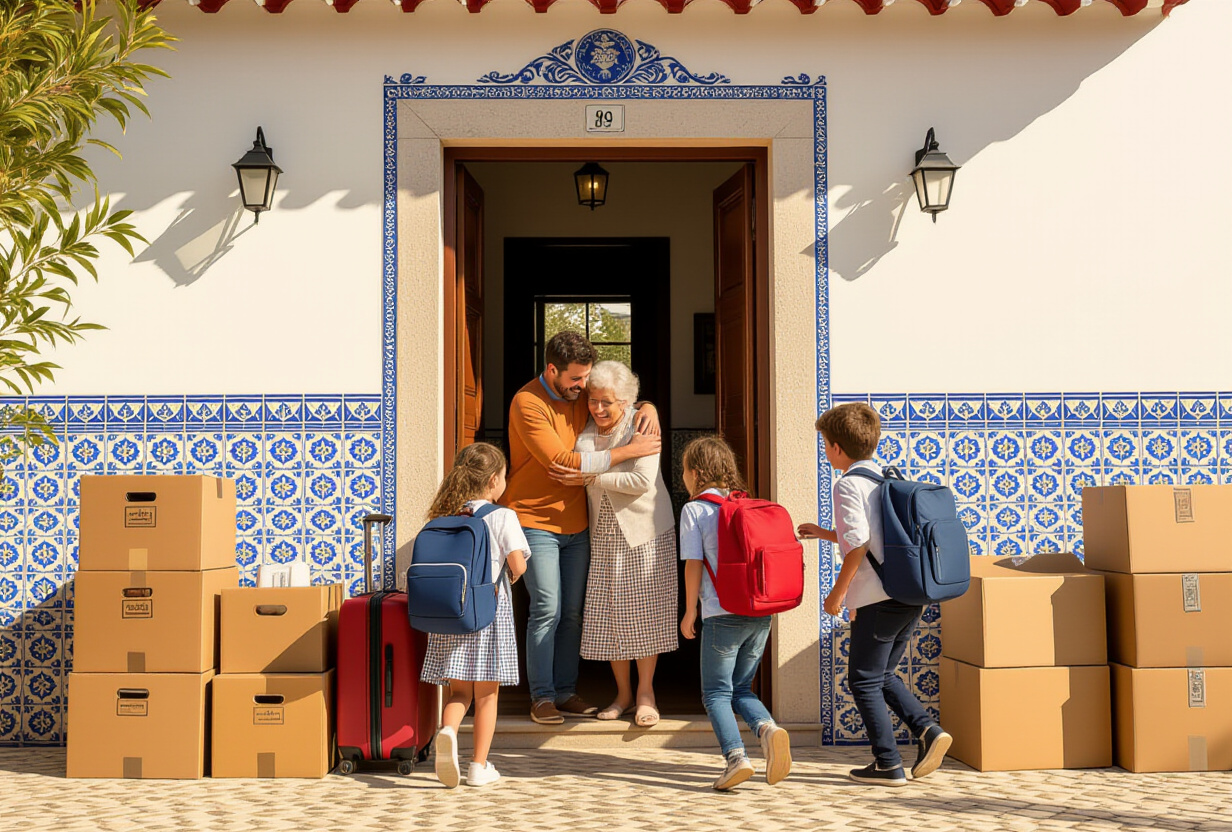
Why does a return home always fail on upstream coordination, never on arrival?
Ask those who returned to Portugal or Brazil after five or ten years abroad. The answer is always the same. D-day is not the problem. The plane takes off, the transport arrives, the cousins pick up the family at the airport, there's a huge welcome lunch with massa de ovos and bacalhau à brás. Everything goes well. What was costly were the months before, where each spouse keeps a part of the information in their head and neither has the complete picture.
The nature of the problem is simple. Returning home means between eighty and one hundred and twenty interdependent tasks, spread over eight to twelve months, to be coordinated between at least two people (the couple) and usually more (children old enough to understand, parents or grandparents who stayed in Portugal and help remotely, the Portuguese school that requests documents before summer, the international mover, the real estate agency that requests a guarantor, French social security to be informed of the return, the Portuguese equivalent to be reactivated). Each interlocutor needs a part of the information, never everything. And the volume exceeds what a single mind can retain.
In usual tools, dispersion is maximal. WhatsApp with parents in Portugal for everything family-related. Emails with the mover and the agency. Screenshots for contracts and quotes. Photos on the phone of furniture to sell or give away. Notes on the native app for shopping lists for arrival. PDFs in Drive or Dropbox. Google Calendar for remote visits with the agency. And a paper notebook, because there's always a paper notebook.
All of this ends up diverging. The new house address is confirmed in an email from the agency, but the spouse is still searching in the WhatsApp history. The price of the Portuguese school was mentioned in a conversation with the aunt, but no one noted it. The deadline for the eldest's diploma equivalency request is in a PDF that no one can find anymore. In the last month before returning, you lose an hour a day searching for information you already had.
What folder structure to manage a return to Portugal as a couple?
The central idea is to replace this dispersion with a single shared space, structured into sub-folders that correspond to the mental piles of a return. In TAMSIV, the recurring pattern for this use case is a main binder named by the destination ("Return Coimbra September", "Voltar para São Paulo", "Moving Porto Summer"), with seven sub-folders.
🇵🇹 Documents: NIF to reactivate, social security to transfer, French and Portuguese residency certificates, driving license to convert, passports to check validity date, children's vaccination certificates to translate. Bilateral tax declarations to avoid double taxation in the year of return. Everything in one folder, with PDFs as attachments, and deadlines in the integrated calendar.
🏡 Housing: remote search for the new house, video conference visits with the agency, rental contracts, the Portuguese guarantor that most agencies require, electricity, water, gas, internet contracts to open. Photos of visited houses, compared quotes, parents' or in-laws' house during transition if applicable. A single place to find the exact address, owner's name, building code.
👨👩👧👦 Family: schedule of planned reunions and celebrations with parents, siblings, cousins. Aunts and uncles to notify. Children's cousins to reconnect with before arrival. The most sensitive tasks here, such as notifying a fragile grandmother without shocking her with the announcement of the return, remain in discussion in the task comments, away from family WhatsApp groups where everything gets mixed up.
📦 Moving: detailed inventory of what goes, what sells, what is given away, what is thrown away. The three international mover quotes compared side-by-side. Loading and delivery dates, customs declaration, international insurance. Box 23 contains the children's books and the grandmother's dishes returning home, and you know where it is three weeks later.
💶 Budget: rental deposit, mover, furniture to buy on arrival (because some furniture stays in France), a fifteen percent margin for unforeseen events. Invoices photographed as they come, automatic total by category, comparison with the initial budget.
🏫 Schools: enrollment in the Portuguese school for the eldest, diploma equivalency that takes months, vaccination certificates to translate, French school report to scan. Choice of pediatrician in the new city, extracurricular activities to resume.
📞 Support: list of people helping remotely. The brother who will pick up the keys to the new house before arrival. The cousin who has a real estate agent friend. The parents' neighbor who offered to keep the boxes if delivery arrives before the family. Contacts for the family doctor, pharmacy, coffee shop where the grandmother goes every morning.
Seven piles, seven folders, nothing left dormant in a forgotten email.
How to share with parents in Portugal, the mover, and the school without exposing everything?
This is where the three access levels delivered at the end of April come into their own. When returning home, you want to involve many people, but each only needs a part of the information. Giving Total access to everyone means exposing the budget to the mover and the children's medical choices to grandparents who just want to help with the deposit money.
The pattern that works for a family returning is as follows.
Both spouses receive Total access to the entire binder. They co-decide everything, modify everything, see everything. No hierarchy between them on this project; it's a couple's project.
Parents or in-laws who stayed in Portugal receive Read access to the Family and Housing sub-folders only. They see the schedule of planned reunions, the new house's address, photos of the rooms. They do not see the budget, administrative discussions, or sensitive documents. They follow along, help when asked, and do not interfere where they don't need to.
The international mover receives Read access to the Moving and Housing sub-folders only, for the duration of the move. They see the inventory to be transported, volumes, departure and arrival addresses, building access constraints. They do not see the detailed budget, administrative documents, or anything about the family. Once the move is done, access is revoked.
The new Portuguese school receives Read access to the Schools sub-folder only, for the duration of enrollment. They see vaccination certificates, translated school reports, medical contacts. They see nothing else.
The real estate agent cousin who helps find the house can receive Write access to the Housing sub-folder only. They can add visits, attach photos of houses they find on the ground, and adjust the criteria list as they go. They cannot delete what they did not create and do not see the rest.
This granularity is not a comfort; it's what makes sharing sustainable over eight months. Without it, you always end up doing everything privately to avoid exposing the budget to parents, and you fall back on WhatsApp screenshots at the end of the day.
How does voice dictation capture ideas between tasks without breaking the rhythm?
Returning home is not a project where you have a quiet hour in the evening to catch up. It's a project where ideas come when you pick up the little one from school, when you leave a professional meeting, when you're driving on the subway, when you're in a supermarket line. If the idea has to wait until evening to be noted, it's lost.
The voice combo in TAMSIV addresses exactly this. You speak for three seconds on the phone, the assistant creates the task, automatically files it in the correct sub-folder, and makes it visible to your spouse in real time. No need to unlock, search for the app, or navigate the tree structure.
Some typical examples of phrases dictated in the midst of preparing for the return.
"Add 'call Aunt Maria to ask if she knows a pediatrician in Coimbra' to Support." After a call from the French school to confirm a date. Three seconds. Task created. The spouse sees it on the phone, calls the aunt at lunchtime, notes the answer in the task comments.
"Add 'scan Tomás's school report' to Schools." In the car leaving the French school, with the freshly handed-over report card. Two seconds, task created, done in the evening once home.
"Add 'request three quotes from international movers Lyon Coimbra September' to Moving." During a break at work. Three seconds, task assigned to self, requests sent at the end of the day.
"Create a memo 'first video conference with real estate agency April 18' in Housing." Right after the call, on the way to the car, you dictate the points discussed while they're fresh. Five lines instead of forgetting half of them.
The central idea is that the friction of adding a task drops to three seconds instead of thirty. Over eight months, that's the difference between a manageable project and one that goes off the rails.
How does the assistant's memory stop re-asking for the home language and arrival municipality?
Returning home adds a cultural and linguistic layer. You speak Portuguese at home, you return to a Portuguese city, the children integrate into the Portuguese school where French becomes a foreign language after years in the opposite direction. If the assistant knows this, you avoid having to repeat the context in every conversation.
The Memory layer delivered at the end of April in TAMSIV addresses exactly this need. You tell it once, "we speak Portuguese at home, we're returning to Coimbra in September, the eldest is 12 and is going into seventh grade at José Falcão Secondary School." This information enters long-term memory, automatically retrieved the next time you dictate a related task ("Add 'make an appointment with the pediatrician near José Falcão school'" without having to re-specify which school).
The assistant can also learn preferences by observation. If you always file Portuguese administration mail in a specific sub-folder, it eventually suggests it automatically. If you always talk about returning in the morning between seven and eight o'clock before taking the children to school, the daily reminders arrive at that time. The friction of re-specifying the context for each task disappears.
What is a typical rhythm for the eight months before returning?
The pace of a well-prepared return has a recognizable shape. It varies depending on the destination municipality and administrative complexity, but the framework is the same.
M-8 to M-6: decision and exploration phase. Announcing the return to the family, choosing the destination municipality, initial housing searches, first contacts with Portuguese schools, announcing to the French employer, beginning of diploma equivalency application if applicable. Many discussions in task comments, few concrete tasks checked off. The binder is built.
M-6 to M-4: administrative phase. NIF application if it doesn't exist or reactivation. Opening or reactivating a Portuguese bank account. Enrollment in Portuguese schools. Requesting three mover quotes. First video conference with the real estate agency. Diploma equivalency in progress. Formal announcement to the French landlord.
M-4 to M-2: housing phase. Signing the remote rental contract, deposit paid, entry inventory done by cousin or parent, electricity, water, gas, internet contracts opened. Final choice of mover. Detailed inventory begins. Sorting what to take, what to sell, what to give away. Announcement to the French school.
M-2 to M-1: operational phase. Final inventory, boxes marked with destination room, change of address in all services (French bank, social security, mutual insurance, twenty-five subscriptions you're signed up for without knowing it). Last purchases of basic furniture for Portugal. French energy cancellations.
M-1 to M-0: transition phase. Final packing, nights on the inflatable mattress amidst boxes, last boxes prepared (clothes and kitchen), transfer of pets to neighbors for the duration of the move, exit inventory of the French apartment.
M+0 to M+1: installation phase. Priority unpacking (bedding, basic kitchen, bathroom), registration at the town hall, declaration of arrival at Portuguese social security, first medical consultation for children, opening mail arriving at the new address, children's first weeks at the new school. The binder remains active to track what is not finished.
M+1 to M+3: archiving phase. The main binder empties, sub-folders that are no longer needed are archived, administrative documents that may resurface a year later are kept (proof of residence, energy contracts, schooling). Six months later, when you need a copy of the signed lease, you find it in three seconds.
What other "long family project with external parties" situations work with this pattern?
The "multi-level access shared binder" pattern can be applied to all coordinations that involve a couple or a small team with several external stakeholders, each needing only a part of the information.
Initial expatriation from Portugal to France or Germany: same structure in reverse, with the administrative complexity of registering in a newly discovered country.
Separation with return to parents: adapted structure, shared binder between separating spouses to divide assets and coordinate procedures, with Read access for the lawyer on legal sub-folders.
Support for an elderly parent returning near family: simplified structure, shared binder between siblings to coordinate support for the parent returning to Portugal after years abroad, with Read access for the nursing home or nurse who will care for the parent.
Student relocation to Portugal from abroad: simplified structure, shared binder between the student and helping parents, with Read access for grandparents following remotely.
In all cases, the mechanism is the same: a single space, several sub-folders corresponding to the project's mental piles, and access levels that allow external stakeholders to be included without exposing everything.
Short Answers (FAQ)
How long before returning should the binder be created?
Eight months for an international return with family, six months for a return without school-aged children, three months for a student returning alone. The binder can remain active for up to three months after the return to archive installation procedures, then be stored for future duplication.
Is a permanent internet connection required to use this system during the transition?
The application works offline for reading and creating tasks. Synchronization occurs automatically as soon as a connection is restored. Convenient on a plane, in a dead zone in the mountains, or in a country where the data card doesn't work yet.
What if one of the spouses gives up along the way?
Practically, unlikely for a project with this level of commitment. If coordination becomes unbalanced (one spouse doing ninety percent), you can use the checklist item history delivered on May 5th to see who checked what in the last thirty days, and discuss with facts rather than impressions. Objective data avoids arguments like "you never do anything."
Can a return be coordinated with only one of the two spouses using the application?
Technically yes, but this would recreate the dispersion we are trying to avoid. The main advantage of the shared binder is that both spouses see the same thing in real time. If only one uses it, the other remains in WhatsApp and emails, and decisions are made across two interfaces in parallel. It's best to take ten minutes together at the beginning to frame the structure and ensure both are comfortable with the interface.
Is the application available on iPhone?
Currently, TAMSIV is available on Android via the Play Store. The iOS version is in preparation. The spouse on iPhone can use the web version to view and edit while waiting for the native app.
What if I'm returning alone, without family?
The structure naturally simplifies. Five sub-folders are sufficient (Documents, Housing, Moving, Budget, Calendar), without the Schools layer or the complexity of sharing with a spouse. Access levels remain useful for including a parent helping remotely, a cousin, or a friend assisting with the transition.